
National Debt vs. Fiscal Deficits: What is the Difference?

Updated: Sep 2
In A-Level and IB Economics, few topics generate as much confusion as the distinction between a fiscal deficit and the national debt. While often used interchangeably in the media, they represent fundamentally different economic concepts.
Understanding this distinction is critical for evaluating macroeconomic policy, analyzing government finance, and achieving top marks in your exams.
Fiscal Deficit: A Flow Concept
A fiscal deficit (or budget deficit) occurs when government expenditure ($G$) exceeds tax revenue ($T$) within a single financial year.
Because it is measured over a specific period (usually 12 months), a fiscal deficit is a flow concept. It represents the rate at which the government is borrowing money to cover its immediate spending shortfall.
Types of Fiscal Deficits
When analyzing deficits, economists differentiate between two main types:
Cyclical Deficit: This portion of the deficit fluctuates with the economic cycle. During a recession, tax revenues fall (due to lower incomes) and welfare spending rises (due to higher unemployment), automatically increasing the deficit.
Structural Deficit: This is the portion of the deficit that remains even when the economy is operating at full employment (normal capacity). It indicates underlying, long-term imbalances in government spending and taxation.
National Debt: A Stock Concept
The national debt (or public debt) is the total, cumulative amount of money owed by the government at a specific point in time.
It is the sum of all past fiscal deficits, minus any past fiscal surpluses. Because it is measured at a specific moment rather than over time, the national debt is a stock concept.
Measuring the National Debt
Economists rarely look at the absolute nominal value of national debt. Instead, they measure it as a percentage of Gross Domestic Product (GDP).
The Debt-to-GDP ratio provides a more accurate picture of a country's ability to pay back its creditors. A high absolute debt might be manageable if the country generates a massive national income.
How Governments Finance Deficits
When a government runs a fiscal deficit, it must finance the shortfall. It typically does this through borrowing.
Issuing Government Bonds: The government sells debt securities (bonds or gilts) to domestic and foreign investors, pension funds, and commercial banks. In return for upfront cash, the government promises to pay regular interest (the yield) and repay the principal upon maturity.
Central Bank Financing (Monetization): In extreme cases, or during severe crises (like Quantitative Easing), a country's central bank may purchase government bonds. This effectively increases the money supply to finance government spending.
The Long-Term Consequences of High National Debt
Running continuous fiscal deficits leads to a ballooning national debt, which carries significant long-term macroeconomic consequences.
1. Opportunity Cost of Debt Servicing
As national debt grows, the government must spend a larger proportion of its tax revenue on interest payments.
This creates a massive opportunity cost. Funds used to service debt cannot be spent on critical supply-side policies, such as infrastructure, education, or healthcare, potentially hindering long-term economic growth.
2. The Crowding Out Effect
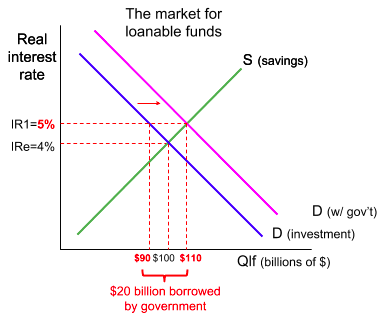
High levels of government borrowing can lead to financial crowding out.
When the government issues large quantities of bonds to finance its deficit, it increases the demand for loanable funds. This drives up interest rates in the wider economy. Higher interest rates discourage private sector investment and consumption, offsetting the initial expansionary impact of government spending.
3. Inflationary Pressures
If a government struggles to borrow from the private sector and resorts to central bank financing, it essentially "prints money" to cover its debts.
This rapid expansion of the money supply, if disconnected from real economic output, can trigger rampant demand-pull and monetary inflation.
4. Intergenerational Inequity
Accumulating large national debt effectively shifts the tax burden to future generations.
Tomorrow's taxpayers will face higher tax rates or reduced public services to pay off the borrowing of today, raising ethical questions about intergenerational fairness.
Summary for Your Exams
To ensure you score highly on fiscal policy questions, remember the golden rule: deficits add to the debt.
A government can successfully reduce its fiscal deficit (e.g., cutting it from 5% to 2% of GDP) while the national debt still rises, because the government is still borrowing, just at a slower rate. Only when a government runs a fiscal surplus ($T > G$) can the absolute level of national debt begin to fall.
Keep studying in the free Economics Portal
Go from this guide into syllabus-mapped revision notes, targeted practice and worked explanations — free to start.
